What Happens During a Dutch Driving Test? A Complete Guide
SEO Title: What Happens During a Dutch Driving Test? A Complete Guide | Rijschool Elvis Maastricht
Slug: what-happens-during-a-dutch-driving-test
Meta Description: Wondering what happens during a Dutch driving test? Learn what to expect during the CBR practical exam, what examiners look for, and how to increase your chances of passing.
What Happens During a Dutch Driving Test? A Complete Guide
Taking your Dutch driving test can be exciting, but it can also feel nerve-racking if you don't know what to expect. At Rijschool Elvis in Maastricht, many students ask the same question:
"What actually happens during the Dutch driving test?"
The good news is that the practical driving test is designed to assess whether you can drive safely, independently, and responsibly. It is not about being a perfect driver. The examiner wants to see that you can participate in traffic safely and make good decisions on your own.
In this complete guide, we'll walk you through the Dutch driving test step by step so you know exactly what to expect on exam day.
What Is the Dutch Driving Test?
The Dutch practical driving test is conducted by the CBR (Central Office for Motor Vehicle Driver Testing). During the exam, a CBR examiner evaluates whether you are ready to drive independently on Dutch roads.
The examiner assesses:
-
Vehicle control
-
Traffic awareness
-
Observation skills
-
Decision-making
-
Road positioning
-
Speed management
-
Independent driving
You do not need to drive flawlessly. Minor mistakes are acceptable as long as they do not create unsafe situations.
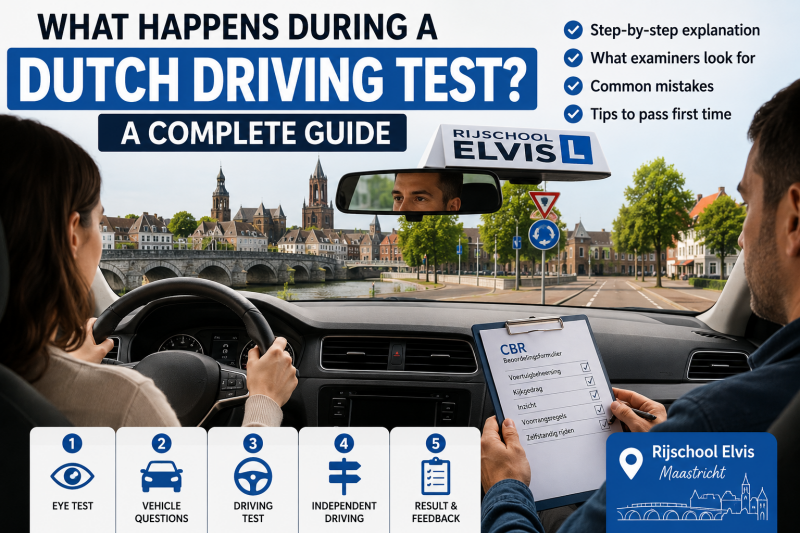
Before the Driving Test
Most candidates arrive at the CBR exam center about 15 minutes before their appointment. The examiner will first introduce themselves and explain how the test will proceed.
The examiner will check:
-
Your valid ID or passport
-
Your theory exam status
-
Health declaration (if required)
-
Other relevant documents arranged through your driving school
After the introduction, you'll head to the vehicle with your instructor and examiner.
The Eye Test
Before driving, you'll usually complete a simple eyesight test.
The examiner may ask you to read a license plate from a distance. If you wear glasses or contact lenses while driving, make sure you bring them. Without adequate vision, the test cannot continue.
Questions About the Vehicle
The examiner may ask one or two basic questions about the car.
Examples include:
-
How do you check the oil level?
-
Where do you refill windshield washer fluid?
-
What does a warning light mean?
-
How do you turn on the lights?
You don't need to be a mechanic, but you should understand basic vehicle functions.
The Driving Part of the Exam
The actual driving portion lasts approximately 35 minutes and forms the most important part of the test. The entire exam process usually takes around 55 minutes from start to finish.
During the drive, you'll encounter different traffic situations, such as:
-
Residential areas
-
Roundabouts
-
Intersections
-
Highways
-
Merging and exiting roads
-
Traffic lights
-
Pedestrian crossings
-
Cyclist-heavy areas
For students taking lessons in Maastricht, this means you'll likely experience a mix of urban traffic, roundabouts, and roads with cyclists and pedestrians. The examiner wants to see how you adapt to changing situations safely and confidently.
Independent Driving
One of the most important parts of the Dutch driving test is independent driving.
At some point, the examiner may ask you to:
-
Follow road signs
-
Follow navigation instructions
-
Drive toward a specific destination independently
This helps determine whether you can make safe decisions without constant guidance.
What Does the Examiner Look For?
Observation Skills
Observation is one of the most important assessment criteria.
The examiner wants to see that you:
-
Use mirrors regularly
-
Check blind spots
-
Look ahead in traffic
-
Anticipate potential hazards
Many students fail because they don't make their mirror and shoulder checks visible enough. Examiners must clearly see that you are checking your surroundings.
Speed Control
Driving too fast is dangerous, but driving unnecessarily slow can also be problematic.
The examiner wants to see that you:
-
Drive at appropriate speeds
-
Adjust to traffic conditions
-
Merge confidently
-
Keep up with traffic flow
Safe and decisive driving is often rewarded more than overly cautious driving.
Position on the Road
Good road positioning shows confidence and awareness.
The examiner evaluates:
-
Lane choice
-
Following distance
-
Positioning at intersections
-
Roundabout behavior
-
Highway driving
Incorrect lane selection and poor positioning are common reasons candidates lose points.
Priority Rules
You must demonstrate a clear understanding of Dutch right-of-way rules.
The examiner watches how you:
-
Give priority
-
Approach intersections
-
Handle roundabouts
-
Respond to cyclists and pedestrians
Failing to give priority when required can have serious consequences during the exam.
Confidence and Decision-Making
The examiner is not looking for a nervous driver who constantly hesitates.
They want to see that you:
-
Make decisions independently
-
Act confidently
-
Stay calm under pressure
-
Continue driving safely after small mistakes
Remember: making one small mistake rarely causes a failure. Unsafe or repeated mistakes are usually the issue.
Common Reasons Students Fail
At Rijschool Elvis, we often see students struggle with the same issues.
Common mistakes include:
-
Insufficient mirror checks
-
Missing blind spot checks
-
Poor observation
-
Incorrect speed
-
Hesitation at intersections
-
Poor lane positioning
-
Missing traffic signs
In many cases, nerves play a larger role than driving ability itself.
What Happens After the Test?
After the drive, you'll return to the exam center.
The examiner will discuss your performance and immediately tell you whether you passed or failed. You'll also receive feedback explaining the decision.
If You Pass
Congratulations!
You can apply for your Dutch driving licence through your municipality after the exam.
If You Fail
Don't panic.
Many successful drivers don't pass on their first attempt. The examiner will explain which areas need improvement so you can focus on them before your next exam.
Tips to Increase Your Chances of Passing
1. Get Enough Driving Experience
Practice helps you develop automatic driving habits and confidence.
2. Stay Calm
Remember that the examiner wants to assess your driving, not trick you.
3. Make Mirror Checks Visible
Clearly move your head when checking mirrors and blind spots.
4. Don't Focus on Perfection
A few minor mistakes are normal. Continue driving safely and confidently.
5. Listen to Your Instructor
Your driving instructor knows when you're ready and can prepare you for the most common exam situations.
Final Thoughts
The Dutch driving test may seem intimidating, but once you understand the process, it becomes much less stressful. The examiner wants to see that you can drive safely, independently, and responsibly.
At Rijschool Elvis in Maastricht, we prepare our students for real-world driving situations—not just for the exam, but for a lifetime of safe driving.
With proper preparation, confidence, and enough practice, you'll give yourself the best possible chance of passing your Dutch driving test.
Frequently Asked Questions
How long does the Dutch driving test take?
The entire practical exam takes approximately 55 minutes, including preparation, the eye test, the driving session, and the result discussion.
How long is the actual driving portion?
The driving section usually lasts around 35 minutes.
Can I make mistakes and still pass?
Yes. Minor mistakes are acceptable as long as you continue driving safely and do not create dangerous situations.
What is the most important thing during the exam?
Observation skills, safe driving behavior, and independent decision-making are among the most important assessment criteria.
What happens if I fail?
The examiner will explain why you did not pass and provide feedback so you can improve for your next attempt.